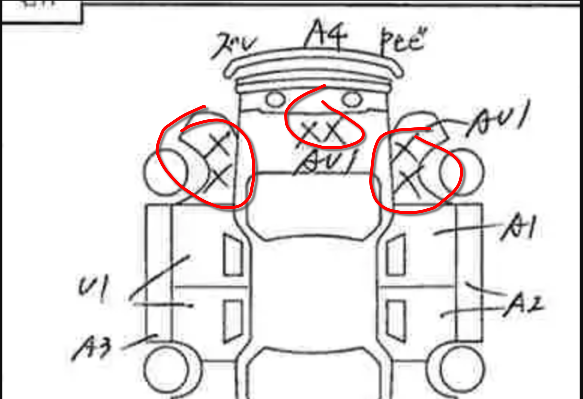
If you’ve spent any time importing cars from Japan, you’ve probably stared at an auction sheet and wondered why two little letters — XX — seem to trigger more panic than almost anything else on the page. It’s a fair reaction. XX is one of the most misunderstood marks on the sheet, partly because it can mean two different things depending on where it appears.
XX Isn’t Always the Same Thing
The confusion starts because “XX” shows up in two separate places on an auction sheet, and each has a different meaning.
1. As an overall grade
Most Japanese auction houses use an overall grade to summarize a car’s condition at a glance — S for near-new, then numeric grades from roughly 6 down to 1, R for repaired, and finally a small handful of “trouble” grades for vehicles the inspector doesn’t want to rate normally. XX (or sometimes just X) sits at the bottom of this scale and is used for cars considered heavily damaged, flood-affected, structurally compromised, or otherwise too far gone for a standard numeric grade. If you see XX as the headline grade on a sheet, treat it as a serious red flag — this is not a car to buy sight unseen.
2. As a panel mark on the diagram
The second, and far more common, place you’ll see XX is inside the little car diagram on the sheet, where inspectors mark individual panels. Here, the alphabet soup works on a rough severity scale:
- A1 / A2 / A3 — small to large scratches
- U1 / U2 / U3 — small to large dents
- W1 / W2 / W3 — barely visible to clearly visible repair/wave marks (a sign a panel has been resprayed or filled)
- S1 / S2 — rust, light to heavy
- X — a panel that needs replacing
- XX — a panel that has already been replaced
In this context, XX on a single panel (say, a rear quarter or a door) is much less alarming than an XX overall grade. A replaced bumper or door after a minor parking scrape is common and often a non-issue. What matters is where the XX appears. XX on a bonnet, roof, or pillar is a different story than XX on a bumper cover, because it can hint at more significant structural repair work.
Why the Distinction Matters When You’re Buying
This is exactly the kind of nuance that trips up first-time importers — and honestly, even experienced buyers occasionally read past it too fast. A few things worth keeping in mind:
- Location on the body matters more than the letter itself. XX on a pillar, chassis rail, or roof panel is worth far more scrutiny than XX on a bumper, since the former can point to accident repair rather than routine cosmetic work.
- Cross-check with the remarks section. Japanese inspectors often add handwritten notes (in Japanese) that explain why a panel was marked. This is where the real story usually lives, and it’s the part that’s easy to miss if you’re only skimming the diagram.
- Don’t judge a car by one mark in isolation. A single XX on a rear bumper, on an otherwise clean grade 4.5 car, is a very different purchase than a car with XX scattered across multiple structural panels plus an R or RA grade.
- Photos and video help confirm what the sheet implies. Where possible, pair the sheet with auction photos or a pre-bid inspection to see whether a “replaced” panel lines up cleanly with the rest of the body.
Other Marks You’ll Often See Alongside XX
Since XX rarely appears alone, it helps to know its neighbours on the diagram:
| Code | Meaning |
|---|---|
| A1–A3 | Scratch (small to large) |
| U1–U3 | Dent (small to large) |
| W1–W3 | Repair/wave mark (barely visible to obvious) |
| S1–S2 | Rust (light to heavy) |
| X | Panel needs replacing |
| XX | Panel has been replaced |
Combined with the overall grade (S, 6–1, R, RA) and the interior grade (A–E), these panel codes give a surprisingly detailed picture of a car’s real condition — if you know how to read them.
The Real Problem: The Sheet Is in Japanese
All of this is manageable once you know the codes. The harder part is that the handwritten remarks — often the most important part of the sheet — are written in Japanese shorthand, sometimes with dialect-specific or dealer-specific abbreviations that don’t show up in generic “how to read an auction sheet” guides. This is where a lot of buyers get caught out: the diagram looks fine, but a two-line handwritten note explaining why a panel was marked XX gets missed entirely.
That gap — accurately translating not just the printed grades but the handwritten remarks — is exactly the problem a good auction sheet translation tool needs to solve. It’s not enough to translate “XX” as a word; the translation needs to preserve where it was marked and what the inspector actually wrote about it, so the buyer gets the full picture rather than a sanitized summary.
Bottom Line
XX isn’t automatically a dealbreaker — but it’s also not something to skim past. Check whether it’s the overall grade or a panel mark, look at where on the body it appears, and always read the handwritten remarks before you bid. A little care at this stage is far cheaper than finding out the hard way after the car lands.