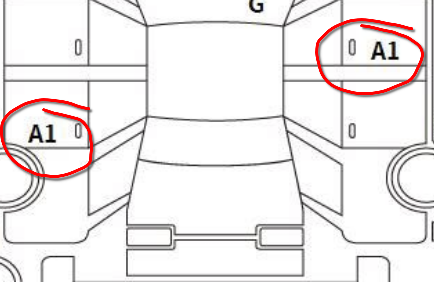
A1 shows up inside the little car outline diagram, stamped next to a specific panel, and it’s telling you something much more precise: there’s a scratch there, and it’s minor.
Reading the code
On the diagram, damage is marked with a letter (the type of damage) plus a number (how bad it is). A is the code for a scratch — kizu, in Japanese. The number that follows, usually 1 to 3, is the severity:
- A1 — small, shallow scratch. Often just clear-coat or paint-deep, sometimes barely visible unless the light hits it right.
- A2 — a more noticeable scratch, deeper or longer.
- A3 — a significant scratch, possibly through to primer or metal.
So when you see “A1” tucked next to the front bumper or a door on the diagram, that’s the inspector saying: yep, there’s a scratch here, but it’s minor. Nothing to lose sleep over.
How to actually find it on the sheet
The diagram itself is small and honestly a bit cramped, so a few tips:
- Zoom in. Most translation tools and scans let you enlarge that section — do it, because at normal size the letters and numbers blur together.
- Match the position on the diagram to the actual panel it’s referencing. The outline roughly mirrors the car from above and from the side, so a mark near the front-left will be the front-left fender or bumper.
- Check for more than one mark on the same panel. It’s not unusual for a bumper to have an A1 and a U1 (scratch and a small dent) both sitting close together.
- Read the handwritten notes too — sometimes inspectors add a word or two clarifying location, like “front” or “edge,” which helps if the diagram mark is ambiguous.
Does it actually affect the car?
Practically speaking, no. An A1 scratch is cosmetic and shallow. It won’t affect how the car drives, won’t affect structural integrity, and in a lot of cases you won’t even notice it without looking closely or catching the light at the wrong angle. This is about as minor as auction sheet damage notation gets.
Fixing it
For something graded A1, you’re usually looking at:
- Buffing/polishing — if the scratch hasn’t broken through the clear coat, a good buff can make it disappear entirely. Cheapest option by far.
- Touch-up paint — for scratches that have gone slightly deeper but are small and localized, a touch-up pen or small panel-safe repair does the job.
- Panel respray — only really necessary if the scratch is longer or more visible than the A1 grade suggests, or if you’re chasing a flawless finish rather than just a functional fix.
For most A1 scratches, a decent detailer can sort it out in an afternoon, and it’s not an expensive job either way.
Effect on price
Honestly — minimal. An A1 scratch on its own barely moves the needle on auction price. Bidders factor it in more as background noise than as a real deduction, especially compared to dents (U), rust (S), or anything marked X (needs replacing). Where it does matter a bit more is if a panel is carrying several minor marks at once (say A1 plus U1 plus another A1), because that starts to suggest a car that’s had a harder life even if none of the individual marks are serious on their own. One A1 by itself? Don’t let it change your bid.
Bottom line
A1 on the diagram means a small, cosmetic scratch — nothing structural, nothing that should scare you off a car you otherwise like. Worth checking the exact panel and glancing for other marks nearby, but on its own it’s one of the least concerning things you’ll find on an auction sheet.