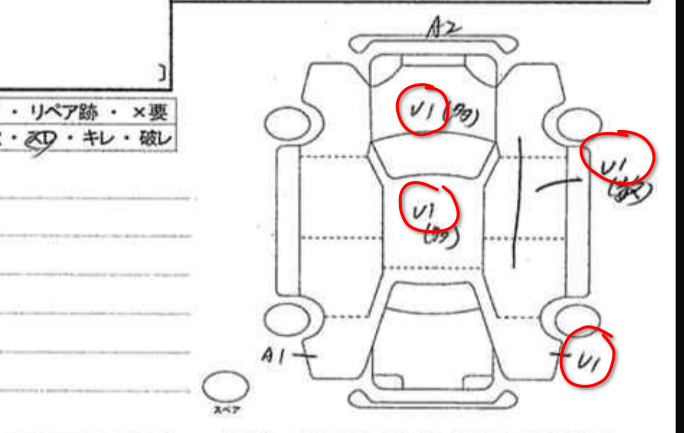
If you’ve looked at a Japanese car auction sheet before, you’ve probably seen a little diagram of the car with letters and numbers scattered around it. One of the most common codes you’ll spot is U1. Here’s a simple, no-jargon explanation of what it means.
What Does U1 Mean?
U1 is a small dent — the kind that doesn’t damage the paint.
Think of the little dings a car picks up in everyday life: a shopping cart bump in a parking lot, a car door tapping the panel next to it, hail damage, or just years of casual parking. That’s what the “U” code is for. It marks a dent where the metal has been pushed in slightly, but the paint surface itself is still intact — no scratch, no chip, no exposed metal.
The number after the U tells you the size:
- U1 — Pin-sized or thumb-sized dent (very small, often barely noticeable)
- U2 — Palm-sized dent (a bit more visible)
- U3 — Larger than a palm (noticeable, harder to ignore)
So U1 is the smallest and mildest version of this dent code. It’s about as minor as exterior damage gets on an auction sheet.
Where Will You See It?
U1 (and U2, U3) will appear on the diagram of the car, usually placed right on the panel where the dent is — for example, on a door, a rear quarter panel, or the bonnet. The inspector marks the location and severity at the same time, so you can see exactly where the dent is and roughly how bad it is at a glance.
Should You Worry About a U1 Mark?
Generally, no. A U1 is considered cosmetic and minor. It’s the kind of thing you’d expect on almost any used car that’s spent time in everyday parking lots and driveways. It won’t affect how the car drives, and it’s unlikely to affect resale value in any meaningful way.
That said, a few things are worth keeping in mind:
- Location matters. A U1 on a rear door is a non-issue. A U1 right on a crease line or body character line can sometimes be more visible than the grade suggests.
- Multiple U1s add up. One small dent is nothing. Five or six scattered across the car might mean it’s had a rougher life, even if each individual mark is graded as minor.
- It’s separate from paint damage. Because a U1 doesn’t break the paint, it generally won’t show signs of touch-up work or rust starting underneath — that’s more of a concern with scratch codes (A1, A2, A3) or panel repair codes (W1, W2, W3).
U1 vs Other Codes: Quick Comparison
It helps to see U1 next to the codes it’s often confused with:
| Code | What It Means |
|---|---|
| U1 | Small dent, paint not damaged |
| A1 | Small scratch, paint surface affected |
| E1 | Barely visible dent (used by some auction houses instead of U) |
| W1 | Panel has been repaired and slightly repainted |
| XX | Panel has been replaced entirely |
The key difference to remember: U codes are about dents without paint damage. If the paint is scratched, chipped, or repainted, you’re looking at a different letter entirely.
The Bottom Line
A U1 on an auction sheet is one of the least concerning marks you can find. It simply means: small dent, paint’s fine, nothing structural, nothing that needs repair. If a car’s sheet shows a couple of U1s and is otherwise clean, that’s a completely normal, low-risk finding — not a red flag.
Reading Japanese auction sheets on your own can still be tricky, especially when a sheet is covered in handwritten Japanese notes and dozens of small codes. That’s exactly what AuctionSheet is built for — upload a sheet and get a clear, plain-English translation of every mark, grade, and note on it.