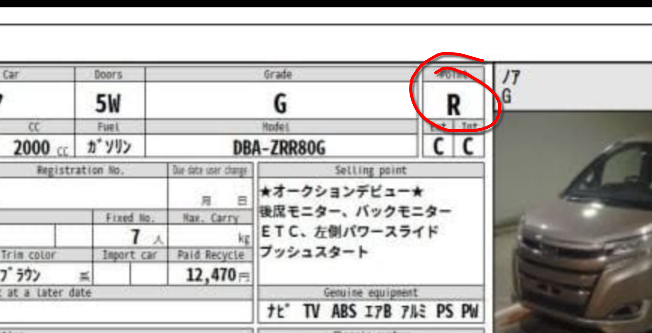
If you have looked at a Japanese car auction sheet, you have probably seen a grade in the top corner. Most of the time it is a number: 4, 4.5, 5, and so on. But sometimes, instead of a number, you see a letter: R.
That single letter changes a lot about the car. Here is what it means, in plain language.
The short answer
R means the car has repair history.
Not just a scratch or a small dent. R means the car was damaged in a way that affected its structure — the welded frame of the body — and then repaired.
You may also see RA. This usually means the same thing, but the repair was lighter or smaller. Different auction houses use these letters slightly differently, so always read the inspector’s notes too.
What kind of damage causes an R grade?
Japanese auction inspectors look at parts of the car that are welded to the body. If any of these have been repaired, replaced, straightened, or show signs of new welding, the car gets an R.
Common examples:
- Front chassis rails (the metal beams behind the bumper)
- Radiator support panel
- Inner wing / apron panels
- A, B or C pillars (the posts holding the roof up)
- Roof panel
- Floor pan
- Boot floor
- Cross members
What does not cause an R grade?
This part surprises people. Parts that are bolted on can usually be replaced without the car getting an R grade, because you can simply unbolt them and fit a new one. That includes:
- Doors
- Bonnet
- Boot lid
- Front wings (fenders) on most cars
- Bumpers
So a car can have had a new bonnet and both front doors fitted and still be graded 4. That is normal and not a red flag by itself.
Is an R car always a bad car?
No — and this is the most important thing to understand.
R does not tell you how bad the damage was. It only tells you that structural repair happened. In practice, R cars fall across a very wide range:
- A car that was lightly bumped in a car park, where the radiator support was pushed in a few centimetres and pulled straight again.
- A car that was in a serious crash and rebuilt.
Both get the same letter. The letter alone cannot tell them apart.
So how do you tell the difference?
You read the rest of the sheet. This is where the real information is.
1. The inspector’s comments. These are handwritten in Japanese, usually at the bottom of the sheet. They often say exactly which panel was repaired and how. Phrases about the front cross member being straightened are very different from notes about the pillars being cut and rewelded.
2. The damage map. The car diagram shows marks for each defect. Look at where they cluster. Damage marks all over one corner tell a story.
3. The interior grade. R cars still get an interior grade (A, B, C, D). A tidy interior on a car with a heavy repair history is worth noticing — sometimes it means the repair was cosmetic and light.
4. The photos. Look at panel gaps around the bonnet and doors. Uneven gaps often show a repair that was not done perfectly.
5. The mileage and year. A ten-year-old car with light front repair is a different proposition from a two-year-old car that has already been rebuilt.
Why R cars are cheaper
R cars usually sell for noticeably less than the same car with a clean grade. This is not because they are all dangerous — it is mainly about resale. When you come to sell the car later, the repair history follows it, and the next buyer will discount it too.
For some buyers, that discount is a genuine opportunity. If you are keeping the car for years, a well-repaired R car can be very good value. If you plan to resell quickly, the discount works against you.
Before you buy an R car, check the rules
Some countries restrict or ban the import of accident-repaired vehicles, or require extra inspection at the port. Rules change, and they vary a lot between markets. Check your own country’s import rules before bidding — this is the mistake that costs people the most money.
A quick checklist
Before you bid on a car graded R:
- Read the Japanese comments — do not skip them
- Find out which panels were repaired
- Look at the photos for panel gaps and paint differences
- Compare the price against clean-grade examples of the same car
- Check your country’s import rules for repaired vehicles
- Ask yourself honestly: am I keeping this car, or reselling it?
The bottom line
R is a warning label, not a verdict. It tells you to look closer, not to walk away automatically. The letter is only the headline — the detail that actually matters is written underneath it, in Japanese, in the inspector’s own handwriting.
If you can read that part, you can find good cars that other buyers skip over.