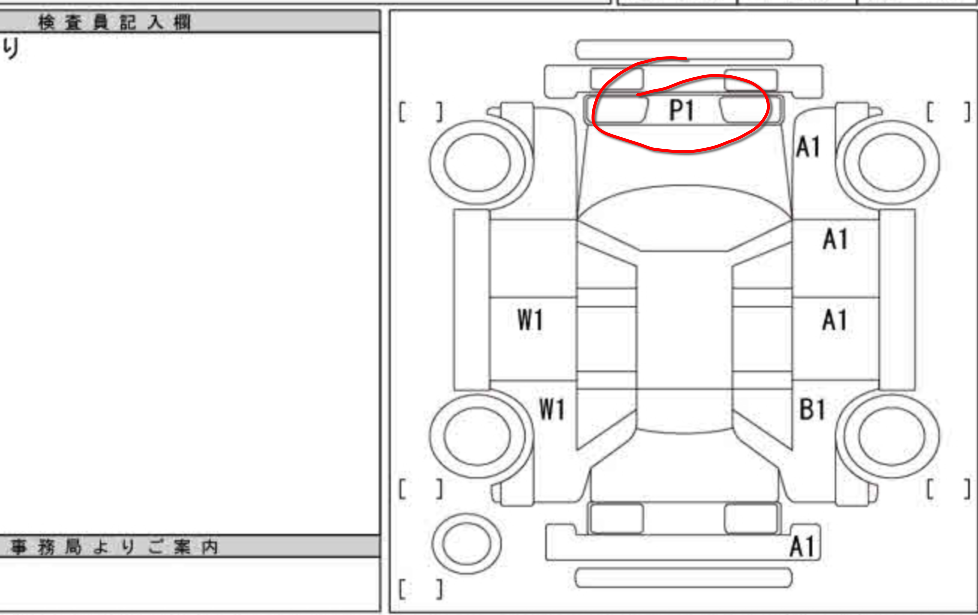
If you are buying a car from a Japanese auction, you will get an auction sheet. On that sheet there is a small drawing of the car. Around the drawing you will see short codes like A2, U1, W2, XX and P1.
These codes tell you what is wrong with each panel. This post explains one of them: P1.
The short answer
P means a paint problem. 1 means it is very small.
So P1 = a tiny paint blemish on that panel. It is the smallest level of paint issue the inspector can write down.
Breaking the code in two parts
Every mark on the sheet has two parts: a letter and a number.
The letter says what type of damage it is. Some common ones:
- A – scratch
- U – dent
- W – panel that has been repaired (wavy or filled)
- P – paint mark or paint problem
- B – dent with a scratch
- S – rust
- C – corrosion
- X – panel needs replacing
- XX – panel has already been replaced
The number says how big it is. The scale runs from 1 to 4:
- 1 – very small, hard to notice
- 2 – small, but you can see it
- 3 – medium, clearly visible
- 4 – large, covers a big part of the panel
Put them together and the code becomes easy to read. A1 is a tiny scratch. U3 is a fairly big dent. And P1 is a tiny paint fault.
What a P1 actually looks like in real life
A P1 is usually one of these:
- A small stone chip that has been touched up
- A small area where the paint has been sprayed again
- A little bubble, blister or peeling spot
- A small patch where the colour does not perfectly match
In most cases you would need to stand close to the car and look carefully to find it. From two metres away, most people would never see it.
Should you worry about P1?
Usually, no.
P1 is cosmetic. It does not mean the car was in an accident. It does not mean the panel was replaced. It does not affect how the car drives.
Most used cars have small paint marks somewhere. Japanese inspectors are simply very strict, so they write down things that inspectors in other countries would ignore.
If the car has a high overall grade (like 4, 4.5 or 5) and only one or two P1 marks, the car is in good condition.
When you should look a bit closer
There are a few times when P1 is worth a second thought:
Many P marks on one side of the car. One P1 is normal. Five P marks on the same side often means that side was repainted, maybe after a knock.
P next to W or XX. If a panel shows P1 and the panel beside it shows W2 or XX, that area has had repair work. The paint mark is part of the same story.
P on a roof or bonnet. Paint problems on flat, sun-facing panels can spread over time, especially on older cars.
A cheap car with a low grade. On a grade 3 or R car, small marks matter less than the bigger issues, but they add to the total cost of tidying the car up.
P1 vs P2, P3 and P4
- P1 – tiny. Often not worth fixing.
- P2 – small but visible. A cheap touch-up or a small blend fixes it.
- P3 – medium. The panel probably needs respraying.
- P4 – large. Expect a full panel respray, and possibly more.
If you plan to sell the car quickly after import, P1 and P2 are fine. P3 and P4 will cost you money at the body shop.
A quick example
Imagine a sheet with these marks:
- Front bumper: A1
- Left front door: P1
- Rear bumper: U2
Reading it is simple: a tiny scratch on the front bumper, a tiny paint mark on the left front door, and a small dent on the rear bumper. This is a normal, tidy used car. Nothing here suggests a serious accident.
The main thing to remember
P1 is the mildest paint mark on the sheet. On its own, it is not a reason to skip a car. Look at the whole sheet: the overall grade, the interior grade, the inspector’s notes, and whether the marks cluster in one area.
Once you learn the letters and the numbers, an auction sheet stops being confusing and starts being one of the most honest documents in the used car world.
Not sure what the rest of the marks on your sheet mean? Upload your auction sheet and get a full translation in seconds.